
'No fault' insurance legislation, ICBC & Enhanced Care—Our Recommendations
Photo: David Horemans/CBC
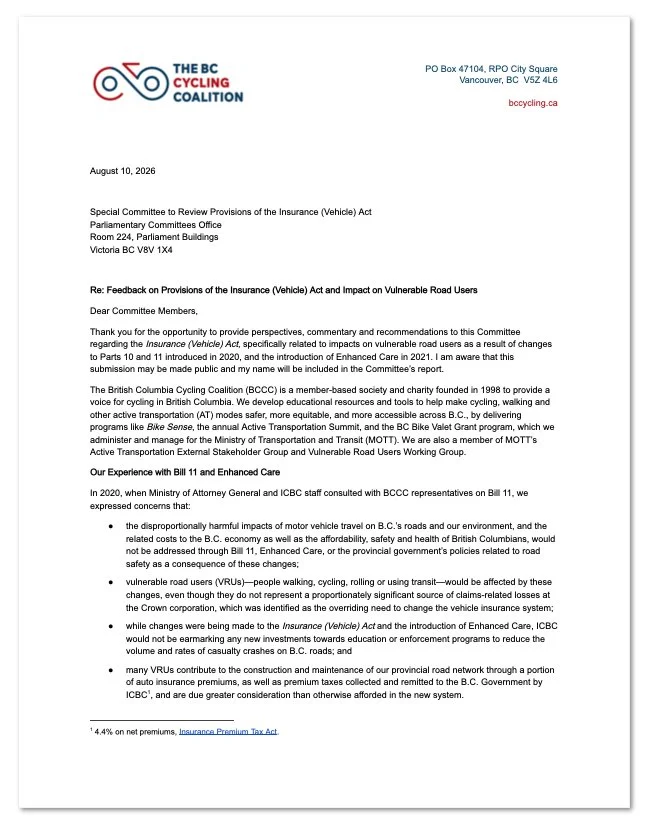
Last month, we were invited to make a written submission to the Special Committee to Review Provisions of the Insurance (Vehicle) Act related to their review of no fault insurance and ICBC’s Enhanced Care (also known as Parts 10 and 11 of the Insurance (Vehicle) Act).
We were also asked for feedback about proposed changes to the meaning of “catastrophic injury” and the time period to make a claim for benefits for a catastrophic injury (Bill M 237, Insurance (Vehicle) Amendment Act, 2026).
However, our chief concern was to provide comments on the justification, merits, and consequences of the no fault insurance system since its introduction in 2020, and the impacts of Enhanced Care, the corresponding regulatory framework for resolving automobile crash claims and injuries, which came into force the following year.
You can read the BCCC’s full submission here; our six recommendations are included below.
In addition to our feedback on the no fault legislation and Enhanced Care specifically, we also recommended that the Committee review gaps in other provincial legislation governing road use and road safety that expose vulnerable road users—people who walk, cycle, and who use other active modes, including transit—to undue loss of rights to care and compensation, in part as a result of Bill 11.
One such gap is the onus of proof of liability for crashes; even in B.C.’s former fault-based system, motor vehicle did not need to disprove their negligence in cases of casualty crashes involving vulnerable road users. Reverse onus, also called presumed liability, is the law in Alberta, Ontario, Nova Scotia, and PEI, as well as in the Netherlands, Germany, Denmark, France, Belgium, Sweden and Norway. We believe the current legislative environment for both vehicle insurance and motor vehicles broadly, reverse onus should form part of the backbone of legislation to both protect the rights of vulnerable road users, and how they are compensated and cared for in the case of a casualty crash.
All written submissions to the Special Committee—163 from individual British Columbians and 27 from organizations like the BCCC—are now available for review on the Committee’s website.
Our Recommendations
Prioritize road safety over premium rate affordability: ICBC’s 2026/27 – 2028/29 Service Plan prioritizes “Affordable Rates” ahead of “Safer and Sustainable Mobility”; we recommend flipping these goals. We believe a greater focus on reducing crash frequency and encouraging customers to drive less (and safely) will do more to reduce crashes—and thus positively impact the loss ratio from claims, and ultimately the overall cost of auto insurance for British Columbians—than through rate affordability measures alone.
Invest all auto insurance system cost savings directly into road safety: From 2020-2024, ICBC invested $4.78 million in pedestrian and cycling safety improvements across B.C., or less than $1 per British Columbian; since Enhanced Care was introduced in 2021, the average ICBC policyholder has received $640 in total rebates. Our survey showed 40% of respondents feel that this is unfair. We recommend that ICBC invest every dollar of savings from Enhanced Care into road safety improvements.
Assign independent medical case managers and social workers to claims involving injuries: Many respondents to our survey expressed fears that resolution of a claim revolves mostly around cost containment; 75% of respondents reported having been in a crash, and when asked if ICBC should handle compensation and care from crashes, almost 50% said “No”. (“Having an insurance adjuster manage my health care and other benefits following a crash is frightening”; “Those same adjusters who have low-balled settlements…are now supposedly going to…offer supports? Impossible to believe…”). The roll-out of Enhanced Care has done little to overcome public cynicism about the claims process.”
Place people who identify as VRUs into the roles of Fairness Officer and Ombudsperson, and on the Civil Rights Tribunal (CRT): To date, VRUs account for 7.5% of the 735 CRT disputes filed, a rate approximately 50% higher than the crash rate involving cyclists and pedestrians. Ensuring that the people charged with resolving complex claims and disputes involving VRUs also have personal experience as VRUs will help ensure claims are resolved equitably; this would likely increase public trust in ICBC.
Track and analyse all claim disputes from VRUs separately: ICBC does not currently track VRU-related disputes that have escalated to the Fairness Officer or the Ombudsperson separately. Due to the disproportionate impacts of road safety risks on VRUs, it’s critical that ICBC begin tracking and reviewing the causal factors of these crashes at every stage of the claims process, especially during disputes.
Update ICBC driver training and materials related to cycling and walking, including the rights and responsibilities of all road users: We continue to recommend that the Ministry of Attorney General and ICBC work with AT and road safety advocacy groups to improve provincial driver training and education content, which did not occur prior to Bill 11 and Enhanced Care coming into force, as recommended at the time. Since the current ‘no-fault’ system was introduced, ICBC has not introduced any that have contributed to a reduction of the top six most common contributing factors in casualty crashes—including speeding, driver distraction, and violations such as failure to yield, improper turns, and ignoring traffic signals—which contribute to the vast majority (86%) of the almost 1,500 fatalities on B.C. roads since 2021. These factors should be addressed without delay by ICBC as part of improvements and enhancements to driver training and education programs.