Active Tourism
With members and partners, the BCCC is working on projects that support the integration of walking, cycling and other active transportation (AT) modes with destination access and outdoor recreation.
-
In 2025, with our partners HUB Cycling, GoByBike BC and Trails BC, we began to work on a shared vision for “BC by Bike”, a destination-oriented, provincial network of great routes to ride, walk and roll.
Alongside our partners, and in collaboration with the B.C. tourism sector, we helped support the launch of the BC Cycle Tourism Society, a provincial nonprofit cycle tourism organization working to build the marketing, standards, partnerships, and policy environment that can help cycle tourism and bikepacking thrive across British Columbia.
On the BC Cycle Tourism website, you can do the following for free:
read Field Notes for the latest active tourism news
-
Destination Canada is helping communities in B.C. plan and grow resilient, inclusive and regenerative tourism economies through the Tourism Corridor Strategy Program (TCSP), a recognition that tourism corridors bring people, places and industries together to strengthen local wellbeing and accelerate sustainable destination development.
The Juan de Fuca Tourism Corridor is the first tourism initiative linking regions across an international border - Vancouver Island in British Columbia and the Olympic Peninsula in the State of Washington. In October, members of the Juan de Fuca Tourism Corridor steering committee will represent the initiative at the 2026 AT Summit in Victoria.
DOWNLOAD→ Juan De Fuca: The First Cross-Border Tourism Corridor
-
Despite global fiscal uncertainty and economic pressures, B.C.'s tourism and service economies are showing encouraging signs of resilience and opportunity:
International visits to BC are back to pre-pandemic highs of over 700,000 annually
B.C. is experiencing its third-highest hotel occupancy rate since the 2010 Winter Games
Spending on food and drink is at an all-time peak, at over $1.5 billion each year
The tourism and outdoor recreation sectors are significant contributors to the provincial economy, with more than 1,400 outdoor recreation and adventure tourism businesses operating throughout the province. A recent study by Squamish Access Society reported that the climbing sector alone contributed $42m in revenue to the local economy in 2025.
The massive growth potential of active travels routes like the Island Rail Corridor, the Sea to Sky Corridor, Experience the Fraser, and the Kettle Valley Rail Trail (and many more) match the world-class potential of the Province of Quebec’s La Route Verte and New Zealand’s Ngā Haerenga Cycle Trail, without delivering any of the economic rewards.
Our growing network of clean, healthy, sustainable transportation infrastructure can only unlock the economic growth potential of B.C.'s outdoor recreation and tourism sectors with increased investments.
Our recommendations to the provincial government for their Budget 2027 consultation includes annual investment of close to $60 million along B.C.’s rural transportation corridors for in AT infrastructure, specifically to support destination access as part of the outdoor recreation strategy and tourism sector action plan.
Look West & B.C.’s Tourism Action Plan
Active tourism is also a transformative approach to destination marketing that now forms part of provincial economic development strategy Look West, the B.C. government's 3-year, $283 million commitment towards strengthening skills training and capital projects province-wide, as the first step in a 10-year plan focused on major investments in energy, trade, and sector action plans.
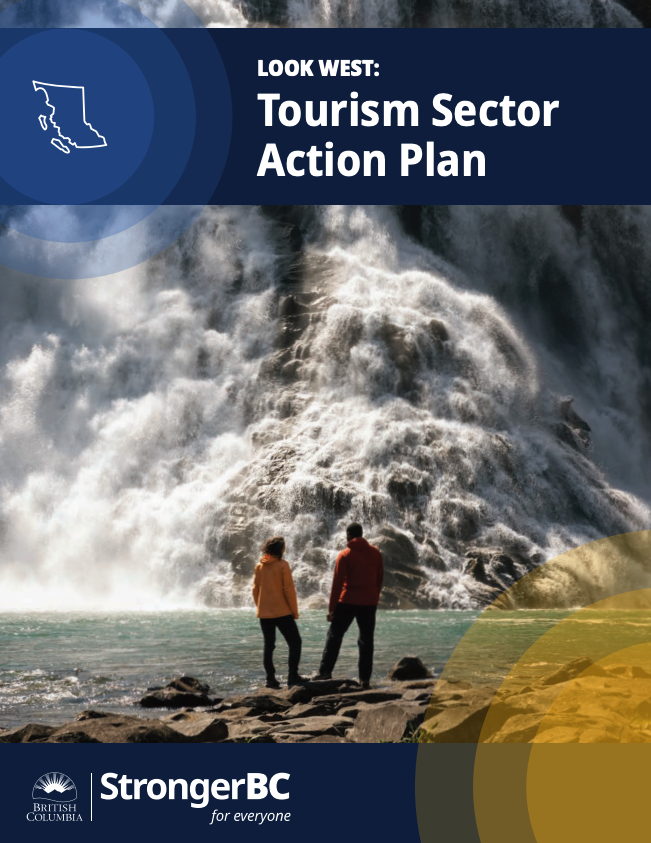
Balancing economic growth, community benefit, and environmental integrity, the Look West Tourism Sector Action Plan released by the Ministry of Tourism, Arts, Culture and Sport (MTACS) recognizes tourism and outdoor recreation as catalysts for sustainable growth and diversification, particularly for local economies and small businesses in rural and Indigenous communities.
In its five-point plan to achieving tourism revenue growth goals and lasting economic benefits for all British Columbians, MTACS identifies destination access as a priority; according to the plan, strengthening multimodal connectivity along regional travel corridors, in alignment with Destination BC’s Iconic routes is part of “widening the doors to B.C.”:
“Improvements to multimodal options – by air, land, and sea – will help visitors experience B.C.’s diverse regions and support local businesses, positioning the province as a welcoming and connected destination.”
Ministry of Tourism, Arts, Culture and Sport