
2026 AT Summit Opening Keynote: Matteo Jarre, Decisio Italia
The following text is a transcript of the opening keynote delivered at the 4th Active Transportation Summit in Victoria on October 29, 2026, by guest speaker Matteo Jarre, Director of Decisio Italia. Thanks to the Consulate General of the Kingdom of the Netherlands.
Bikenomics, the Price of Business as Usual, and How to Win the Argument for Cycling
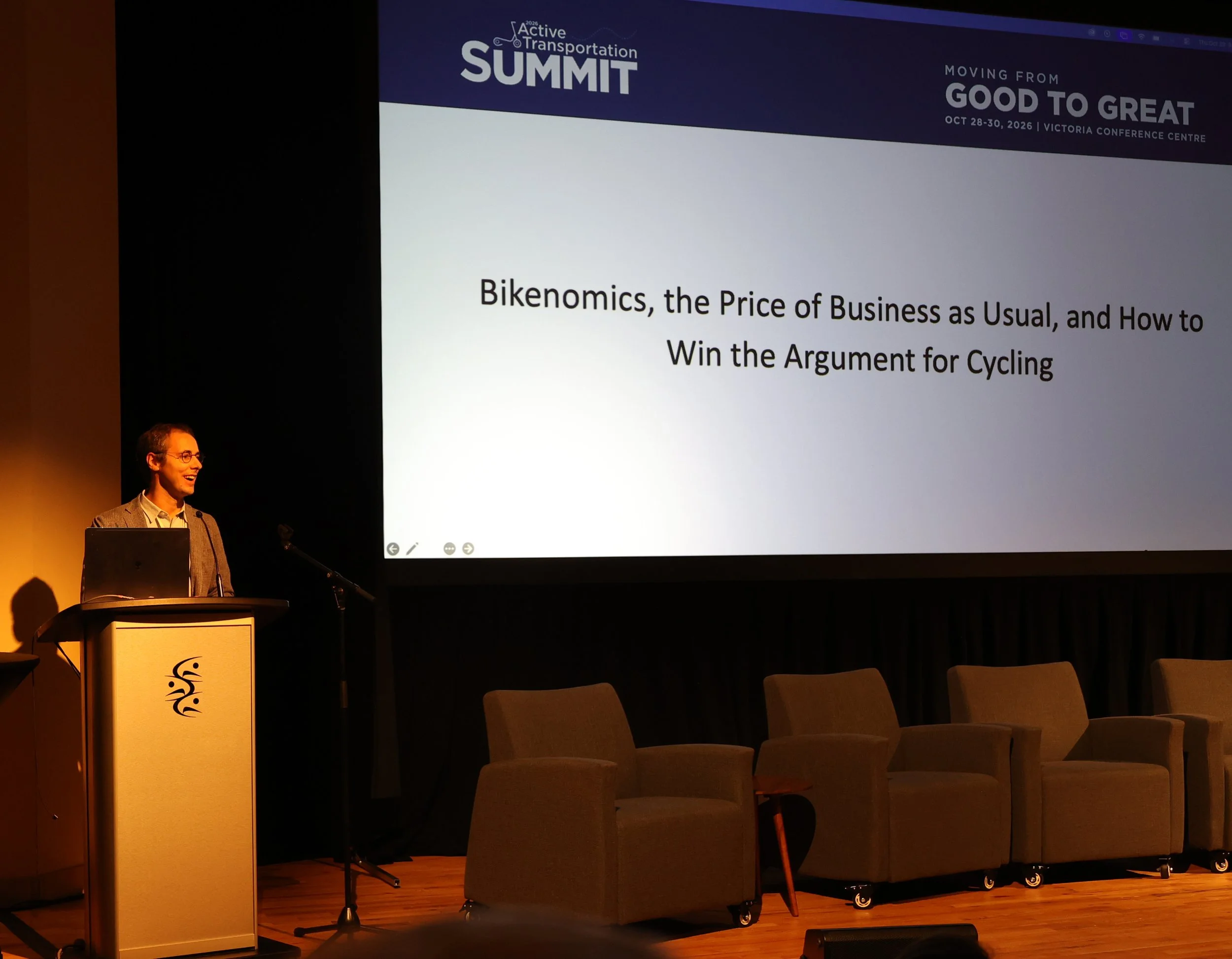
Thank you very much for the wonderful introduction.
I'm one thousand kilometers away from home so you'll forgive me if my voice is trembling a little bit. An Italian guy speaking on behalf of the Dutch Consulate about Dutch experience in cycling at a conference in Canada. It sounds like the beginning of a joke, right?
We're trying to bring you the Dutch experience, the Dutch infrastructure, and the Dutch way of thinking about cycling in Italy. I work in Torino - the Detroit of Italy, the home of Fiat. We have a culture that considers cyclists and bikes as something that should be removed from the street as much as possible. This has been true since I was a kid. Right now things are changing a little bit - slowly, but they are changing.
The Dutch experience is strong in me, and also I know exactly how difficult the cultural differences are that exist between the Netherlands and the rest of the world. I did a little experiment yesterday evening as I was finalizing my presentation. I typed 'cyclist' in English on Google Images—what does a person who uses a bike look like?
According to Google Images, the first 20 images, they look like this—they’re white, a man, between 30 and 40 years old, more or less. They're fitter than me. More importantly, they're on a racing bike or a mountain bike. They're cycling; they're not going to work. They're not going to pick up their kids. They're cycling because that's the sport that they do. And that's, I would say, probably 100% of the images there. That's what a cyclist look like.

So I wrote exactly the same word, but in Dutch—fietser. And there's a different image. Finally, women appear. Not only 30 years old, but 60 years old, and five or 10 years old. And more importantly, people are going to work. People are going to pick up their kids. People are going for groceries, et cetera. People are not cyclists in the sense that they identify with this category of being an urban warrior or somebody who bikes for sport.
They're just normal people, they're doing what they want. They just so happen to do it by cycling.
The rest of the world usually treats cycling as something that you do as a kid. You become a real adult and you buy a car and you drive just like everybody else. That's the norm. As adults, we're allowed to cycle on a Sunday when we go for an ice cream—or at least that's what we do in Italy - but we don't do it Monday to Friday. A normal person doesn't cycle to work.
When I was an engineer by training, we had meetings and I would go by bike and once my boss told me that I needed to park my bike around the corner. This was not 20 years ago, this was five years ago. Yes, I needed to park my bike around the corner because it was better not to be seen coming to the engineering "real adults" type of meeting by bike.
Of course in Europe we love our Tour de France, we love our Giro d'Italia—again, cycling with a helmet, of course with a racing bike, but that's it. What I would like to talk about is how we can change this framework to make it so that active mobility in general, walking and cycling, not just cycling, is actually considered as a proper means of transport.
But even more so, if we consider it as a proper means of transport, we can also make it economic development, we can also make it social development.
My speech is about four things. One: it's not only a design challenge. During the conference we will hear amazing examples of very good design, which is super important. It's part of the work that we do as Deciso. But I would say that the underlying challenge—or the challenge that comes before that—is actually how do we convince people to fund our projects enough so we can do good design?
Many times the good design is actually not possible because we don't have the money. We don't invest enough in cycling. What's the baseline, what’s the system that we have now?
I'll also give a couple of examples of how we present results, and how this was used and is still being used in the Netherlands to bring about the change we so much care about. It's very much about how we present cycling. This is really the core of the presentation.
For example, we talk about the fact that cycling infrastructure is very expensive. It's a million dollars, or ten million dollars to build that protected bike lane on Main Street, and we must do it for the environment. This is a losing argument. I'm sorry, but not everybody cares about CO2, especially now that we have the affordability crisis. People have, or they think they have, more pressing and more important problems.
So if you talk about CO2 and only about CO2, you're not going to convince everybody, which is a shame.
The real point is that active mobility is actually very cost effective in improving the quality of life of our cities in so many aspects.
Then there's the problem of us against them. "As a mayor or as premier, I can't invest in cycling because only 2% of the population is cycling. I can't prioritize those few people and I can't invest in them and give space to them because this is going to disadvantage normal people—people who drive."
Actually, this fight doesn't exist. If you prioritize cycling, you're actually doing a very good service to drivers as well; it's just hard to explain.
The average speed of cars during rush hour in Utrecht is much higher than the rush hour speed in Vancouver and the reason for that is you have less competition for the same road space. If everybody uses a car, you're fighting with everybody. If I bring my kids to school by bike instead of a car, then immediately the competition is less, the road is a bit emptier. This is very important to explain: there is no real fight. Investments in cycling are actually doing a service to drivers as well.
Finally, there's the problem of advocating and being an activist. If you're a mayor or premier and you want to promote cycling, you're scared that you're going to be seen as an activist. You're going to be seen as partisan. But the opposite is true. If you're not investing in cycling, you're actually doing a disservice to your community. You're actually missing on a great opportunity, which is an opportunity in terms of economic development of your city and province.
Because of these four things, the argument is lost before it can start.
We underestimate the benefits, taking the broad implications of cycling and putting it into this very narrow cage of the environment, which is important but it's not sufficient.
The costs are overestimated in the sense that we actually fail to understand that our current system is very expensive. We have to actually invest money, spend money—it's two different terms. If I spend money, it's lost. If I invest money, I want something in return. That's very important. We never consider what our system looks like now, and we never consider what the negative impacts of the way we move around are today. So again, what is this baseline?
The mobility system that we have today is very dangerous. There are tons of statistics about Canada—I checked and double-checked this statistic—to make sure it was actually true. Last century, road transport killed more people than both world wars combined. But there aren’t any movies with Tom Hanks about this. Because we don't see it—it happens every day, one of those diffused impacts that we don't see. It's not in your face.
Just to give you an idea, in Canada last year, three times more people were killed on roads than killed by homicides. Again, you have homicides on the news. every single day, whereas you don't see car crashes.
In Vancouver last year, 112 hours were lost during rush hour. The average speed during rush hour was 17 kilometres an hour. Running a half marathon under two hours is way faster than that. Even I could keep up for five minutes. On a bike, you can keep up with that. And actually this is the reason why so many of you cycle, right? It's a very simple thing. We're faster and we know it.
Rush hour doesn't make any sense—it's a productivity problem.
People who are stuck in their cars can't work, and they also usually give up on so many other activities. Think about how many of our lives actually have to be reorganized around the very fact that rush hour is terrible. We have to reorganize our lives around this very fact because we can't make a mobility system that works in a better way, even though this is the result that we get with all of our engineering prowess and power and roads and bridges. Rush hour, 17 kilometers an hour. Thank you very much.
Why does it happen? It happens because the car is not very efficient. It's not very efficient in terms of allocation of space and we know this again very well. I'll show a picture I took in the Netherlands of a very tiny European Renault Twingo. You have a 2.5 meters wide road on the right and a 2.5 meters wide road or a bike path on the left. The one on the left carries 35 people, more or less, and the other one carries one. And this type of crazy allocation of space is what causes so many of our problems.
Since this is active transportation, can you stand up please? This is going to be a bit of a biased experiment because you're not exactly representative of the general population, but please sit down if you agree, yes, I exercise enough, - the level of exercise I get every week is proper. If instead, like I did, you bought that gym subscription on January 2nd last year and you went there two times, then remain up. OK, have a look around, please. This is no shaming. I'm standing up myself. OK, thank you very much. You can all sit down.
I thought you would have done better to be honest. I'm going to an active transportation summit, so everybody's going to be fit and—no! Guys, come on, cycle more!
But this is very representative of the situation in Canada, actually. Half of the Canadian population doesn't get enough exercise. And once again, this is a huge problem. And this is a social problem. Being in a place in which people are out of shape, don't exercise enough, is a huge economic problem, because we have to take care of their health, especially when they get older. They are more prone to many types of health problems. These are huge economic problems.
This is about much more than just CO2—it's a much broader issue, which is also, of course, a much greater opportunity.
UNICEF puts out a report every year, and every single year, the Dutch kids are on top of the list in terms of happiness. Now this happens for one specific reason—they're rich. I know you thought I was about to say cycling. Yeah sure, but it's not just that. Okay, in a rich society kids are exposed to a lot of opportunities and that makes up, on average, 80 to 90 percent of the score. But the report also mentions cycling every single year, every time. Cycling is mentioned as something that makes Dutch kids have greater opportunity, greater independence, greater autonomy, and it's in the report every single time as a key factor in contributing to their happiness.
Half of Dutch kids cycle to school by themselves, alone, when they're in primary school, 5 to 12. And basically everybody cycles to school when they're teenagers. Teenagers bike to school. If you have ever been to Amsterdam, Utrecht, Rotterdam, any Dutch city, you've actually seen it. And if you're like me, you've actually been a bit scared about this. Because what you see around, it's 7.30 a.m. and you see one kid just go out and they start cycling and they are nine years old, eight years old. And you look around for the parents - where are they? They are not there. And then one more kid comes up and one more kid comes up and then all of a sudden there is a flock of 15 kids. They're all eight years old. They don't cycle fifteen kilometres at 8 years old, they cycle two to three kilometres, but they cycle by themselves. They get to school and this makes their independence and their autonomy, as you can imagine.
You could say, yeah, I'm not a parent, I don't give a damn about kids cycling, this doesn't concern me. But even if you're not a parent, you have to think about this and remember the very fact that in so many other countries, the fact that everyone has to drive their kids to school does impact rush hour very much.
When schools close for summer, suddenly rush hour is completely different. You're like, "what's happening? Oh yeah, school's closed." So the situation is completely different and you can actually see it for yourself.
There have been studies about the relationships between people in neighbourhoods—how much do you know your neighbours? Do you have dinner together? Do your kids play together? These kind of things. And they correlated responses with the amount of traffic that was present on the street.
And the result is, as you can imagine, there is some relationship. If you have a hard time crossing the street, you don't know each other very much, and the neighborhood isn't so cohesive. And this goes up to how much you know each other.
Lighter traffic streets create cohesive neighbourhoods; they create bond between neighbours.
I find this amazing . We don't often think of traffic as something so powerful. We would think that if we want cohesive society, we have to work on so many issues. We would never think that we have to work on transport and on public space, but we actually do and there's a huge opportunity there.
The conclusion is not just about for or against CO2—it's not just a green transport thing. It encompasses so many factors, so many aspects of our lives. A city, a province, a country in which people cycle more or walk more is so much better in so many factors. We have to remember to talk about this when we try to motivate people to invest in cycling.
How do we do this? It sounds very nice, but it's just talk, right? Whereas with many of these factors you can actually put a number to them. You can understand the impact.
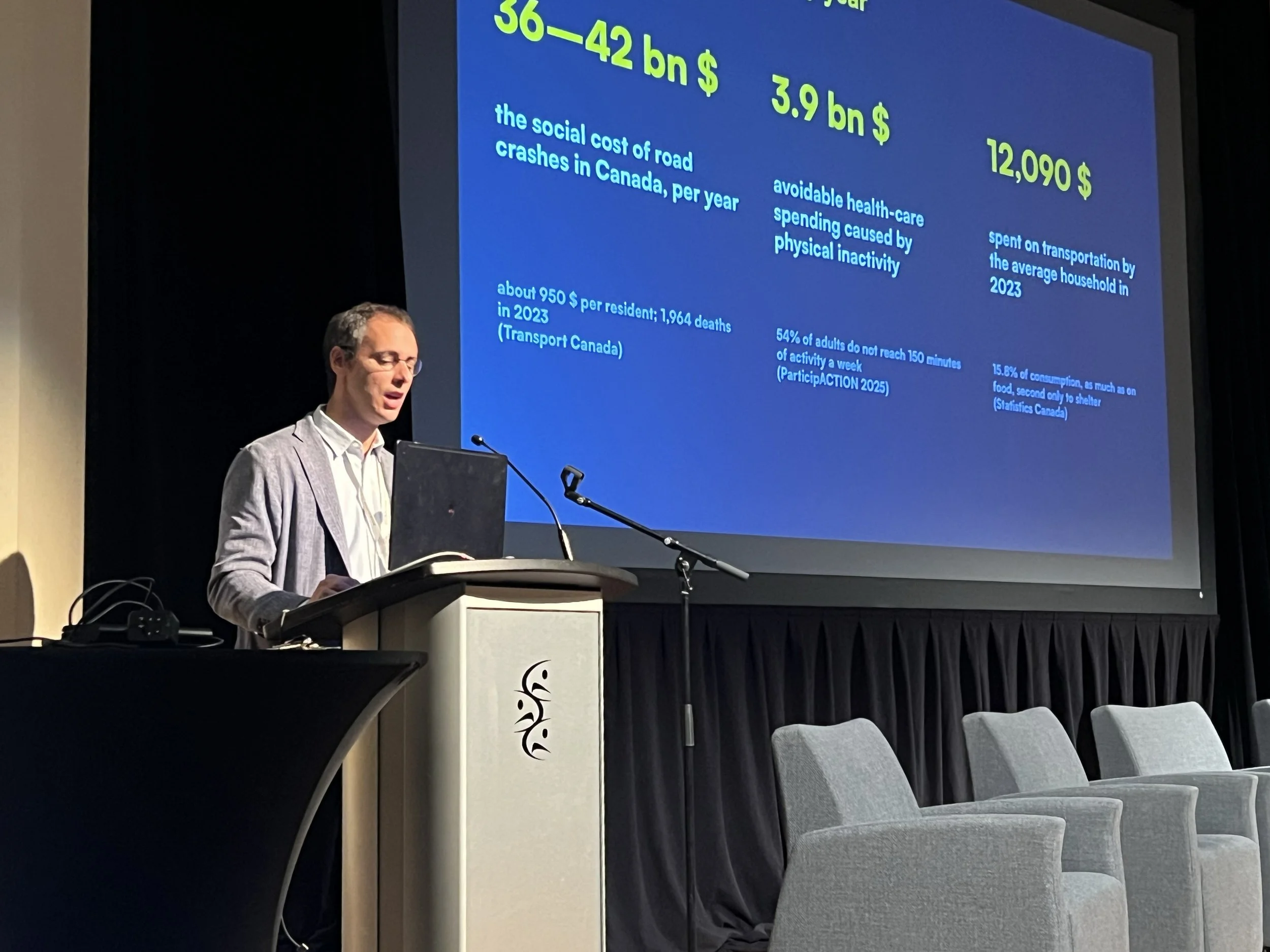
Talk about quality of life—what does it mean? Here are just three examples I found, and it's quite easy to find. In Canada, about $40 billion is spent every year on avoidable health care expenditures. because of you not being active enough. This is social impact, but it's also part of the affordability crisis. Every single household spends, on average, $12,000 every year on mobility.
And a society that doesn't give any alternative to the car is basically forcing everybody to say, on January 1st every year, "I have to put aside $12,000 because of transportation—because I don't have any other alternative."
The point is business as usual is very much not neutral.
The situation that we have now is not working and is very expensive. But we just don't think about it. It's the fish not knowing what water is, right? We don't think about it because we're so accustomed to this system that we don't think that it has a very important negative impact and it's very expensive. Which means that if we think about cycling as an investment option, we think about it as something that we have to spend money on.
This is about reframing—thinking about investing, not spending.
Here are some examples of the work that we've done at Decisio. The first one is Utrecht to Amsterdam, probably the most cycling-friendly place in the whole world. And even there, in a place in which 50 % of people cycle, if you invest one euro, you get 2.8 euros in return in terms of socioeconomic benefits. If you do it in Lima, in Peru, where basically nobody was cycling when we performed a study, the return is 19 to 1. If you get a phone call and somebody promises 19 to 1, that's a scam. Nobody's going to offer you this type of return on investment in a bank. Not even crypto would dare to offer 19 to 1. But 19 to 1 is the benefit to cost ratio of investing in cycling in Lima.
So you have to communicate it in a proper way. Yes, of course we can do all our dry reports with the 25 pages of methodology, but this is impossible for people to understand or to digest. So you have to make an infographics, with video preferably.
This is the example from Lima. The 19 number was front and centre, of course, as it must be. We did it in Milan, where the return on investment was 3.5. I think it was 350 million euros and they would have had 1.1 billion euros of socioeconomic benefits if they'd invested in cycling.
I know what you're thinking now. "Yes, yes, sure, you're Italian, very nice, but still you come from the Netherlands. This is still a Dutch example and we're not the Netherlands."
I understand that. Because the thing is that, if it wasn't clear enough by the amount of numbers I've given you, I'm a nerd. This is a map of the Netherlands. Bear in mind, there are no borders on the map. I've not drawn any borders but you can see where the Netherlands starts and finishes—those are cycle lanes, so you can actually see the border between the Netherlands and Belgium and France and Germany based on the amount of bike lanes. You've seen the pictures and you think the Netherlands has always been like that—a cycling paradise. They just have it in their DNA. We will never be able to do it.
I know, because I think the same of my own country sometimes. But it has not always been like that. They were developing in the 40s, in the 50s, in the 60s, just as Canada was developing, just as Italy was developing around the car. This is the centre of Amsterdam in the 1960s and the centre of Utrecht in the 1960s. And they had these big projects, just like you and I had, where they would wipe out the residential district to make space for freeways.
This is Nieuwmarkt, the very centre of Amsterdam. There they had cars around the historic buildings—you know the drill. If you're interested in the history, we can talk about it later. But they changed their perspective about cycling. Dutch people really don't like inefficiency, don't like wasting time. They come together around the idea that by making a society cycle more and walk more, you can have all those benefits that we talked about and slowly but surely they made their way.
It was a painfully slow process. It took them 50 years, but now they're in the situation that you know.
The rest of the world doesn't need to take 50 years. We can do it in 10 years.
Paris has been doing things in the last 10 years which are amazing. The city is completely different and they did it in two mandates of the mayor, eight years. So the idea here is, yeah it changed because of the technical capability for sure, but also because they reframed their understanding around cycling.
You know the painting "Ceci n'est pas une pipe" by René Magritte—this is not a pipe, for a painting of a pipe. Well, I like to borrow it from him. This is not a cycle lane. This is how we have to think about it.
It's not a cycle lane. It's health policy, it's public transport infrastructure, it's education policy. It's one way that we can support the disadvantaged people and its quality of life. And we have to think of it as such. So the question really is not can we afford to spend money on cycling? It really should be, "can we afford not to invest in cycling?" And I think we cannot, I think we should invest in cycling.
I'm curious what you think. Enjoy the conference. Thank you very much.