
Have Your Say: Motor Vehicle Act Reform
B.C.’s roads and highways are becoming increasingly dangerous for vulnerable road users.
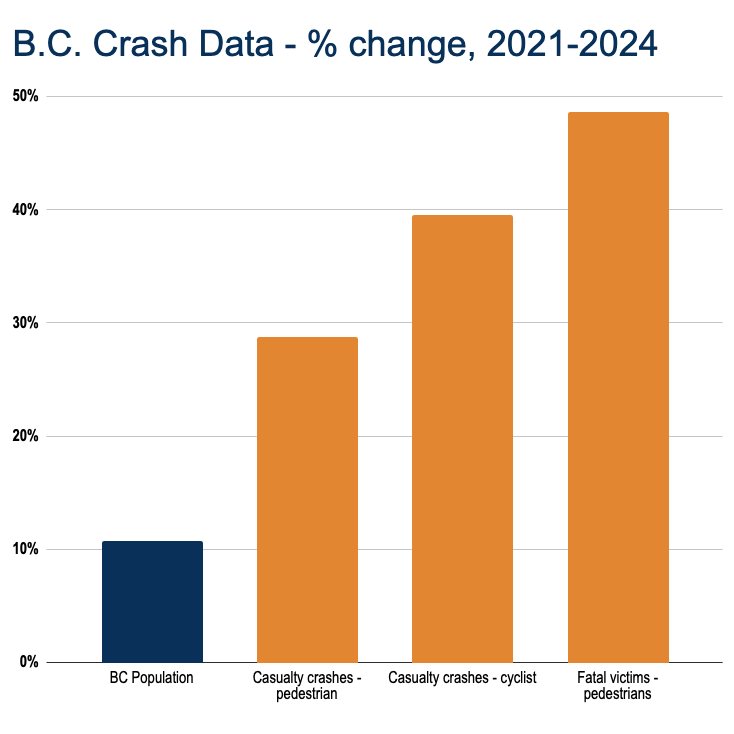
See “In B.C., Crash Rates Are Rising Faster Than Population”, below. Source: “B.C. Crash Data”, 2021-2024, licensed under ICBC’s Open Data Licence.
Despite recent changes intended to support road safety, the most recent ICBC crash data shows that crashes that injure or kill cyclists have increased four times faster than population growth since 2021. Pedestrian deaths have grown five times faster. Quite simply, casualty crash and fatality numbers on B.C.’s streets and highways are going the wrong way.
It’s not just the volume of crashes that’s noteworthy; the majority (86%) of the almost 1,500 fatalities on B.C. roads over the past five years are due to six contributing factors, all of which road safety laws exist to address—speeding, driver distraction, and violations such as failure to yield, improper turns, and ignoring traffic signals.
Some of the increase can be attributed to ‘mode shift’, or the increasing rates of cycling and walking, which is outpacing growths in driving trips. More cycling and walking does mean more risk exposure.
However, the increased risks on our roads is impacting everyone. The growth in casualty crashes for all road users is outpacing population growth, as are crashes—particularly intersection crashes—and fatalities overall.
We desperately need to reverse these trends on our streets and highways, and one obvious place to start is with the 70-year-old Motor Vehicle Act (MVA). As the legal statute that covers all road users, the MVA is the main tool for addressing safety risks on our roads and driving enforcement. And the MVA is of particular interest to active transportation advocates who seek stronger protections of the rights and duties of bicyclists and pedestrians.
The B.C. government is considering future changes to the MVA reform, with consultations starting last month. Many active transportation advocacy organizations, including the BC Cycling Coalition, are consulting with their members to get their feedback on potential MVA reform.
We’ve been down this road before. For the past 10 years, we’ve worked as part of various groups to provide recommendations to the provincial government on much-needed updates to the MVA. In 2020 and 2021, we worked with local governments and our members to advance a resolution through various government associations in support of minimum passing distances, or ‘safe passing’. MVA changes proposed by government in 2023 included safe passing, which went into effect in 2024. The safe passing law requires vehicles to leave one metre (at speeds under 30 km/hr) or 1.5 metres (over 50 km/hr.) when passing cyclists.
Unfortunately, educating drivers about safe passing and enforcing it remains a challenge. But the success with safe passing did signal something important: that the provincial government recognizes that risks to cyclists and other vulnerable road users are very real and must be addressed. More needs to be done with laws and enforcement.
You can help make B.C. roads and highways safer.
In 2024, HUB Cycling and BCCC—along with a group including local governments, health authority, NGO and private stakeholders—submitted a series of 25 changes to the MVA for the provincial government to consider. They include the following five recommendations:
Implement a 30 km/h default speed limit for all neighbourhood streets
Prohibit motor vehicles from turning right at red lights
Require drivers to give a 3-second distance when following vulnerable road users
Prohibit parking in or blocking bike lanes, and automate fines
Standardize LPIs (“advance green”) at traffic lights for all vulnerable road users
We’d like your opinion—check out the recommendations from BCCC and HUB, then go to our survey to let us know what you think. We’ll share a summary of survey results to the provincial government.
You must be a member to fill out the survey. It’s easy (and free) to become a BCCC Member—join now!
In B.C., Crash Rates Are Rising Faster than Population
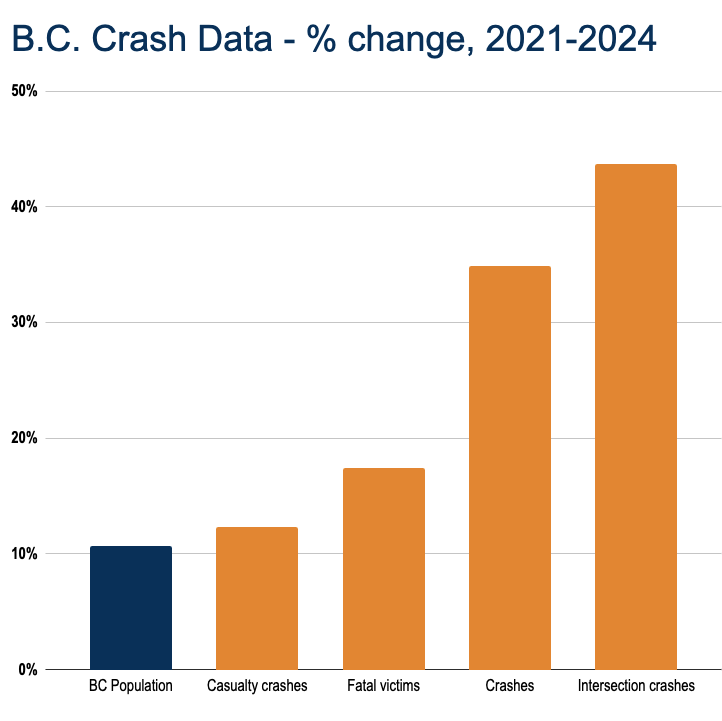
Source: “B.C. Crash Data”, 2021-2024, licensed under ICBC’s Open Data Licence.
ICBC data from the period spanning 2021-2024 show that crash trends are exceeding expectations tied to population growth. Over these four years:
The change in B.C.’s population and driver licensing were both approximately 10%
Crashes and intersection crashes rose 35% and 44% respectively
Casualty crashes—crashes involving an injury or death—also showed unexpected increases, particularly for vulnerable road users.
The four-year change in all casualty crashes was 12%
Casualty crash rates involving pedestrians increased by 29% (three times population growth)
Casualty crashes involving cyclists grew by 40% (four times population growth)
Pedestrian fatalities increased by 49%
Source: “B.C. Crash Data”, 2021-2024, licensed under ICBC’s Open Data Licence.
The Motor Vehicle Act is the legal statute covering all road users in B.C., including people on bicycles.