
CleanBC Review - summary of independent report to government

Read the CleanBC plan - March 2019 update.
Yesterday, Minister of Energy and Climate Solutions Adrian Dix was joined by the Green Party of BC’s Jeremy Valeriote, MLA for West Vancouver-Sea to Sky, to deliver the final report of the review of the provincial government’s 2018 CleanBC climate plan.
We were made aware of the review this past summer when our members expressed concern that a recent pause to B.C.’s recurring annual active transportation grants was being attributed to this review process.
CleanBC & Active Transportation
CleanBC, introduced in 2018 “as a pathway to a more prosperous, balanced, and sustainable future”, led directly to Move Commute Connect, the province’s active transportation strategy, launched at the 2019 AT Summit hosted by BCCC.
CleanBC-related investments in active transportation over the years have included:
matching funding to local and Indigenous governments for the planning and construction of active transportation routes and facilities, via the BC Active Transportation Infrastructure and Network Planning grants - between $9 million and $24 million in total annual grant funding;
the e-bike rebate program which awarded 7,000 rebates to e-bike consumers from 2023-2025, totalling $10 million; and
financial support for events, encouragement and education programs operated by BCCC, BEST Mobility, Capital Bike, GoByBike BC and HUB Cycling, and many other groups across the province.
CleanBC has also contributed to significant investments towards supporting electric vehicle and plug-in hybrid technology development, EV subsidies, and EV infrastructure and programs.
Transportation context
Since 1993, total GHG emissions in B.C. have risen 20%, largely due to the growth of emissions from road transportation.
GHG emissions from motor vehicles grew by 34%; after energy combustion, road transportation is now B.C.’s largest source of emissions.
Motor vehicles account for almost 1/4 of all GHG emissions in B.C.; road transportation contributes more emissions than industry, agriculture, waste, and land use combined.
The Report
The report presentation included an introduction to the report’s consulting team, responsible for leading the review and providing recommendations to government.
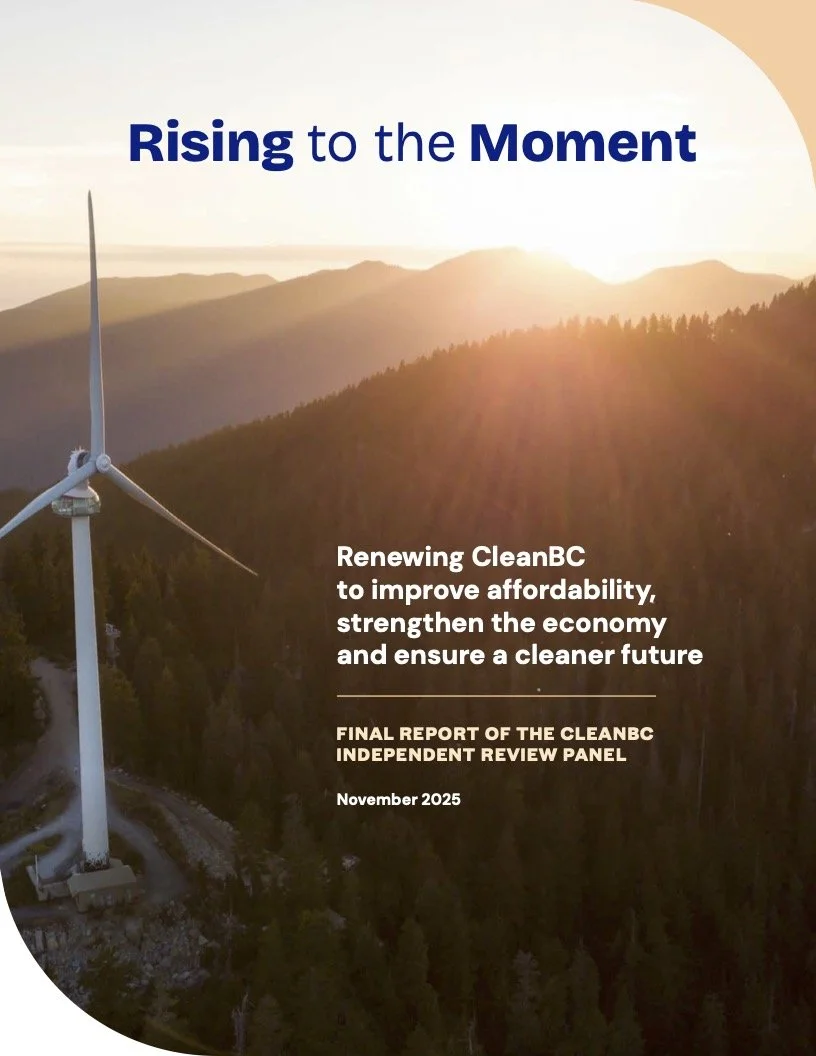
Read the final report of the CleanBC independent review panel.
The team’s overall message: CleanBC is working.
Two values were proposed to government as guiding principles for CleanBC going forward:
Protect affordability
Keep BC competitive
Suggested supportive actions in the consultant’s report included:
Renew CleanBC, not retreat; extend and strengthen approaches that are working.
Calibrate approaches for regional fairness, affordability and achievability; focus on making it easier to adopt solutions.
Recycle any revenues that come from climate solutions resulting from CleanBC climate policies “back into climate solutions, and to do that transparently”.
The core recommendations seemed to focus primarily on initiatives related to vehicle electrification; in several instances acknowledging the benefits of non-vehicular transport.
Overall, however, the opportunity to put forth a strong set of active transportation policy recommendations appears to have been overlooked, and do not appear in the report’s eight principles and seven priority areas.
Instead, there is a considerable focus on changes to road transportation infrastructure and passenger vehicles, including a suggestion to remove the province’s planned ban on internal combustion engine vehicles and EV mandate, as was the case in the original CleanBC plan.
This focus was flagged by review participants,
…[who] also emphasized that a shift to cleaner fuels and EVs will not address the numerous other issues that arise from continued vehicle reliance, including public expenditures on road construction and maintenance, economic impact of time lost to congestion, air and noise pollution, and more. Transportation-sector stakeholders expressed uniform disappointment that the province did not deliver its long-promised Clean Transportation Action Plan, despite significant consultation. (p. 33).
Our Position on the CleanBC Review
The BCCC endorses the report’s two recommended actions addressing active transportation, and we encourage our members to contact their local MLA to express support for and follow-up response on:
A call for a workable model for funding active transportation; and
Establishing "kilometres of new AAA bike lanes installed" as a visible and publicly reported climate progress indicator.
Report Excerpts
The province is also supporting active transportation through investments that provide cyclists with safe and more direct connections to schools and jobs. In its 2023 budget, the province committed $100 million to fund such active transportation infrastructure over three years.
While this represented the province’s largest investment of its kind until that point, given active transportation’s extensively documented co-benefits, the amount is modest. (To put it into perspective, the funding amounts to 0.2% of the $5 billion the province subsequently directed to widening Highway 1 through the Fraser Valley.)
An independent analysis of the province’s income-tested e-bike rebate program concluded it generated new (marginal) e-bike purchases and displaced vehicle use. The researchers recommended minor modifications that would improve a future iteration of the program.
Beyond reducing climate pollution, active transportation affords significant health benefits; a growing body of evidence suggests the dollar value of public-health gains often exceeds the cost of infrastructure investments.
The CleanBC Roadmap to 2030 update included a target that, by the end of this decade, at least 30% of trips made by British Columbians would be on foot, bike, or transit. While transportation stakeholders lauded that goal, most agreed it was more ambitious than achievable.
Stakeholders broadly agreed that the benefits of shifting travel to transit and active modes extend well beyond reducing climate pollution, and include enhancing affordability, improving economic productivity, and cleaning the air.
Recognizing this broad societal value, participants underscored the imperative for a sustainable funding model that would pay for both public transit and active transportation infrastructure. They urged the province to take up this challenge and not narrowly consider these investments as CleanBC line items. [page 34]
While the review offers no specific recommendation to increase investment in protected bike infrastructure to a specific amount or per capita allocation, it appears to be generally acknowledged that AT infrastructure is an obvious low-carbon investment; on page 63 of the report, the consultants recommend that the province track kilometres of new AAA infrastructure as a publicly reportable progress indicator.