
Active Travel Benefits
Having the ability to get around on foot, by bike, or micromobility device is what makes a transportation system accessible, efficient, and fair. However, many of their benefits of active travel tend to be overlooked or undervalued.
This page lists various types of benefits to communities that invest more in active travel modes—both the facilities and programs to support them—and provides evidence of for these benefits.
Source: Todd Litman, Victoria Transport Policy Institute (VTPI).
Many people want to walk and bicycle, and will do so with supportive environments and conditions, such as sidewalks, crosswalks, bikeways, and lower traffic neighbourhoods.
During the last two decades, per capita automobile travel has peaked while, while the share of active mode shares have increased significantly—particularly in communities that improve their facilities, suggesting that people want to walk and bicycle, but will only do so if they feel safe. Whether due to health and environmental concerns, rising vehicle costs, or the accessibility of new technologies such as e-bikes and scooters, demand for non-auto travel is increasing .
5-Year Change in Transportation Mode Share (%), Capital Regional District
2017
2022
In the CRD from 2017 to 2022, total regional automobile trips declined 13%, and average daily auto trips per capita declined 20%, all despite 9% population growth. These declines were largest in core communities that invested the most in sidewalk, crosswalk and bikeway improvements.
Active travel is good for the economy.
Surveys indicate that many motorists would prefer to drive less, rely more on non-auto modes, and save on transportation costs (National Association of Realtors, 2023). As a result, property values, business activity and property tax revenues tend to increase as communities become more walkable and bikeable.
Multimodal transportation allows households to spend less on vehicles and fuel, leaving more money for them to spend on locally produced products, generating more jobs, profits and tax revenues; research indicates that in most cases, AT-related improvements like streetscaping, bikeways and traffic calming benefit businesses. Even removing parking spaces can benefit business by creating more attractive commercial districts that attract more customers, workers and residents, which increases businesses overall.
Related studies:
“Economic impact on local businesses of road safety improvements in Seattle: implications for Vision Zero projects,” Journal of Injury Prevention.
“As Downtowns Struggle, Businesses Learn to Love Bike Lanes,” Bloomberg.
The Battle Over Bike Lanes Needs a Mindset Shift, Wired.
Business Grew After Controversial Bike Lane Installed, Data Show, New York City Streetblog.
“Economic Impacts on Local Businesses of Investments in Bicycle and Pedestrian Infrastructure: A Review of the Evidence,” Transport Reviews, Vol. 41:4.
Understanding Economic and Business Impacts of Street Improvements for Bicycle and Pedestrian Mobility - A Multi-City Multi-Approach Exploration, Portland State University’s Transportation Research and Education Center.
“Measuring the Local Economic Impacts of Replacing On-Street Parking With Bike Lanes,” Journal of the American Planning Association.
Improving active travel increases fairness.
In a typical community, 30% to 50% of travellers who don’t drive will use active modes…if they’re convenient and safe.
During the last century, most governments invested less in active modes than their potential share of trips. As a result, many streets lack safe sidewalks, crosswalks and bikeways. Investing in active modes provides non-drivers their fair share of infrastructure investments.
Non-Auto Travel Demands
In a typical urban community, about half of travellers cannot, should not or prefer not to drive, and will use other modes if convenient and comfortable to use. This justifies more walking, bicycling and public transit improvements, policies to create more compact and walkable neighbourhoods, and eliminating parking mandates so households aren't forced to pay for parking facilities they don’t need.
Active modes are far more affordable than motorized modes.
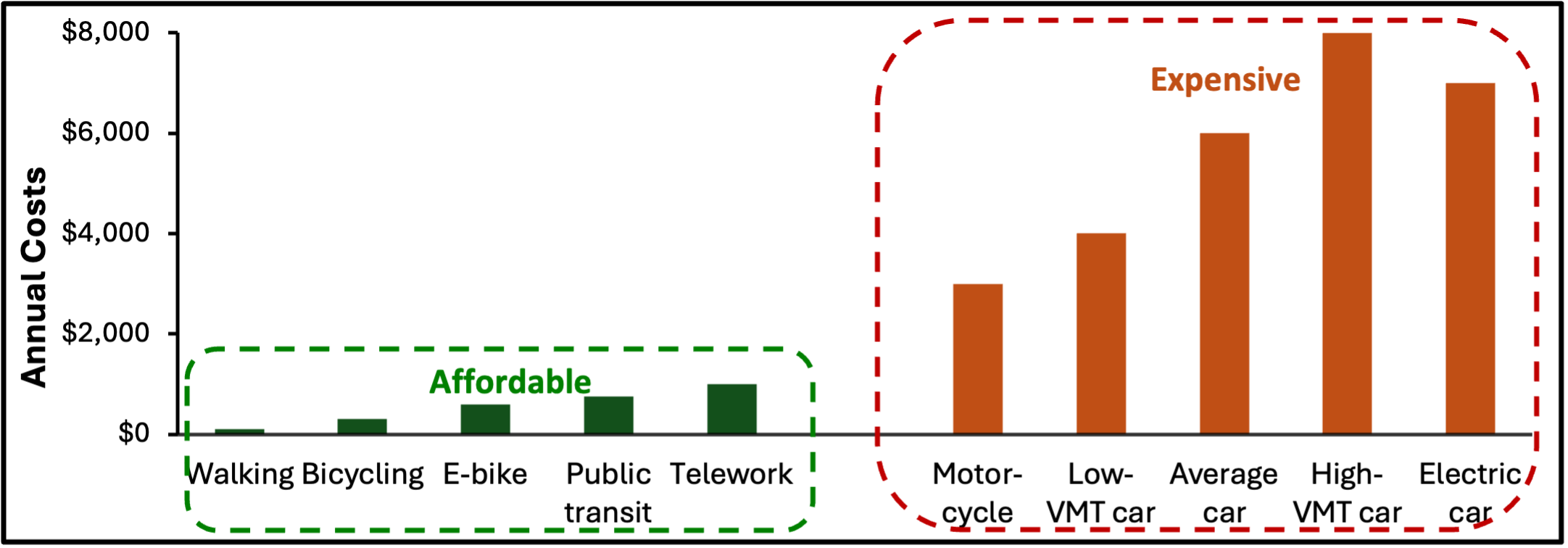
Many people want more affordable transportation; improving sidewalks, crosswalks and bikeways is the most effective way to do so. A typical household can save thousands of dollars annually by giving up a car and using active modes for local trips. However, these savings are only possible if walking and bicycling are convenient and safe.
Typical Annual Costs by Travel Mode (Litman 2025)
Active modes require far cheaper infrastructure than driving.
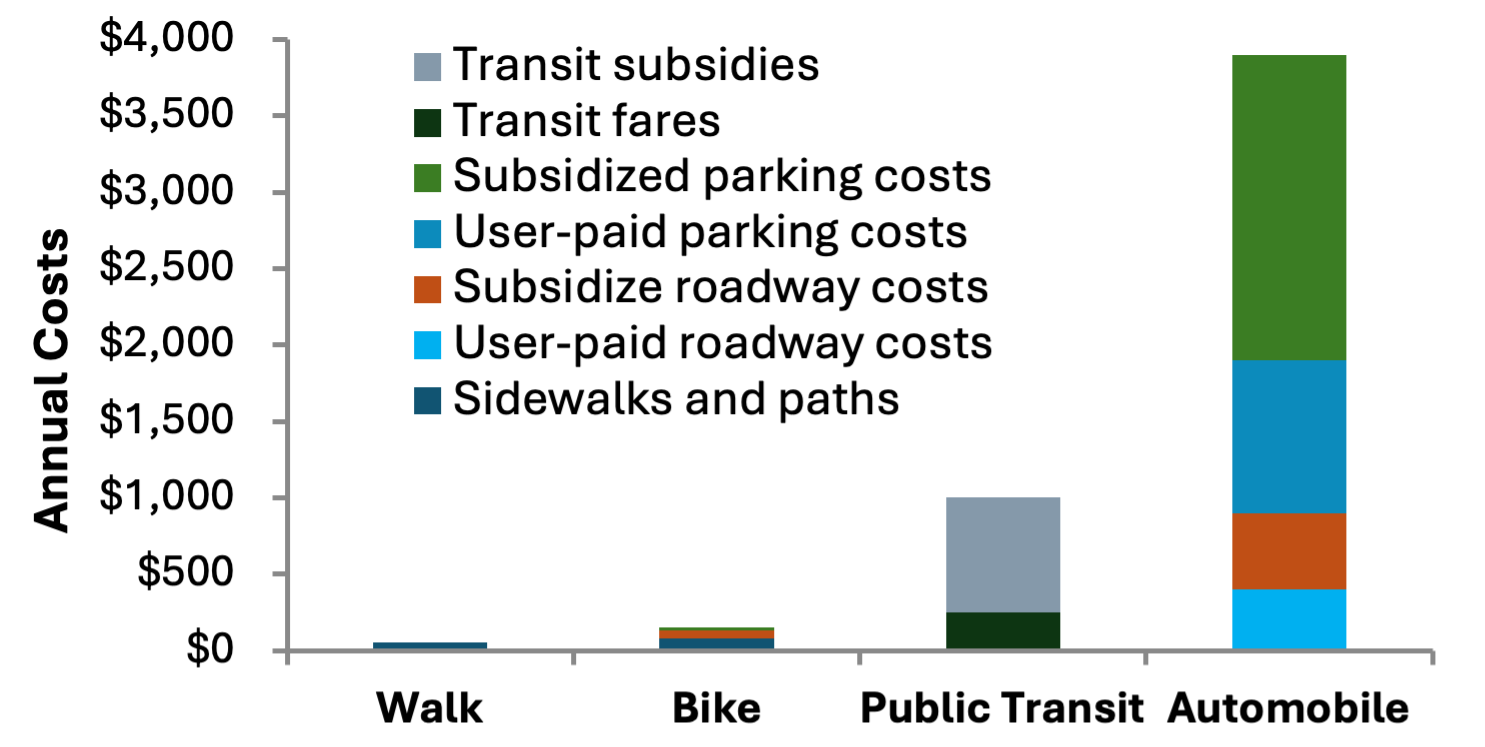
Every time somebody purchases a car they expect governments to spend hundreds of dollars per year to provide roads and property owners to spend thousands of dollars per year to provide off-street parking for their use. Walking and bicycling require far less costly infrastructure, providing savings to governments, businesses, residents and taxpayers.
Public Infrastructure Costs (Litman 2025)
Everybody benefits from more active travel, including motorists.
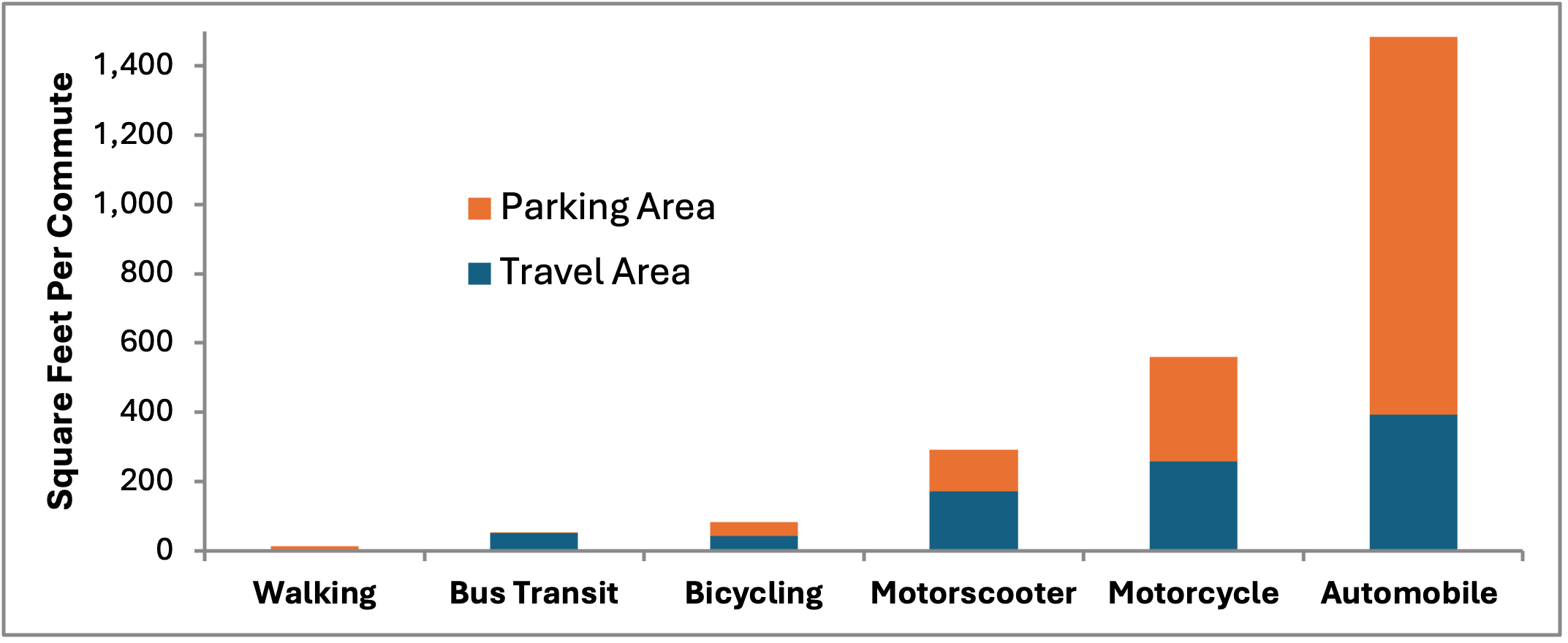
Motorists benefit from active mode improvements through reduced traffic and parking congestion, increased safety, and reduced chauffeuring burdens. Walkers, bicyclists and public transit passengers require far less space for travel and parking than motorists.
Although critics focus on occasional delays that crosswalks, bikeways and bus lanes sometimes cause to drivers, these are generally offset many times over by reduced driving trips and drive times.
For example, Victoria’s bikeway network displaced about 200 on-street parking spaces between 2017 and 2022, contributing to the reduction of 6,000 cars owned by Victoria residents, and the reduction of 46,120 automobile trips in Victoria. The loss of parking spaces was more than offset by reduced car ownership and trips, reducing parking problems overall.
Active travel improves neighbourhood livability.
More walking and bicycling makes neighbourhoods safer, quieter, healthier and more friendly. Studies find that as walking and bicycling increase and car traffic declines in neighbourhoods, the number of crashes, crimes, noise and air pollution goes down, Furthermore, residents have more positive interactions with their neighbours, public fitness and health increase, mental health and happiness improve, and local businesses become more successful with more active travel.
Walking and bicycling improve fitness, health and happiness.
For physical and mental health, experts recommend that adults engage in moderate exercise at least 150 minutes per week, and twice that for children. Although there are many ways to exercise, many require the allocation of dedicated time and expense. For most people, walking and bicycling are the most practical way to maintain lifelong fitness. Walking and bicycle networks — sidewalks and bike lanes — are ‘exercise machines’ that connect your home with neighbours, shops, schools and parks.
More active transportation means more independence, less auto-dependency burdens on drivers.
Active modes benefit drivers by reducing their chauffeuring burdens; in automobile-dependent areas, more than 10% of trips are simply to transport a non-driver. Improving non-auto modes allows non-drivers to travel on their own, saving drivers time and money.
Safe walking and bicycling conditions give non-drivers independence — to run local errands, and by providing access to public transport. This access benefits youths, seniors, families with low incomes, and tourists (as well as motorists, when their vehicle is unavailable).
Active travel reduces pollution, directly and by supporting public transit travel.
Automobile travel is the largest single source of noise, air and water pollution for most households. Shifting some of your trips from driving to active travel and public transport is one of the most effective ways to create quieter, cleaner and healthier communities.
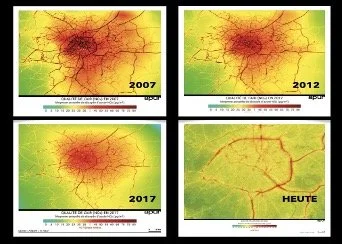
Since 2007, the city of Paris has significantly reduced air pollution and associated deaths through a combination of policies focused on reducing car traffic and promoting cleaner transportation. Beginning in May 2016, Mayor Anne Hidalgo has overseen the introduction of a scheme called "Paris Respire" (literally "Paris Breathes") in order to combat air pollution in the city, which has included banning all cars from certain areas of Paris on the first Sunday of the month, as well as making public transport and the city's bicycle and electric vehicle schemes free for the day. She has also worked to reduce car usage in part through raising the cost of parking at street-side meters, by banning free parking on certain days, and by converting certain sections of a highway along the River Seine into a riverside park.
Paris Pollution Concentrations (City of Paris)
Active travel is climate friendly, protecting greenspace, reducing heat islands and stormwater management needs, and preserving wildlife habitat.
Most governments provide free parking on most streets, and mandate abundant off-street parking. This activity displaces trees, and increases heat island effects and stormwater costs. Communities designed for multimodal travel, conversely, need less pavement for roads and parking lots.
Space Required by Travel Mode (Litman 2025)
Critics of active travel often exaggerate its costs and underestimate its benefits.
Complete streets, sidewalks, traffic calming and bikeways are no more “anti-car” than a healthy diet is “anti-food.” Although these changes may slow traffic down, by improving walking, bicycling and public transit they increase accessibility overall. Numerous studies find that sidewalk and bikeway improvements increase business district prosperity by improving non-auto access and creating more attractive environments for shoppers, workers and residents.
While active mode improvements initially face opposition by people who fear change, once changes are completed public support often increases; even better, streets become safer and more livable, and local businesses prosper.